Clinical Qualifications

Advanced Training in Independent Examination

Not every chiropractor is qualified to perform an independent medical evaluation. The IME requires a set of clinical skills distinct from those used in treatment: objective examination without therapeutic intent, familiarity with AMA Guides impairment rating methodology, structured report writing to clinical and legal evidentiary standards, and the credentials to defend findings under deposition or testimony.

Dr. Moore holds the Certified Independent Chiropractic Examiner (CICE) designation — a post-graduate credential earned through training and examination on the AMA Guides with the American College and American Board of Independent Medical Examiners — and is a Member of the American College of Independent Medical Examiners (MACIME). His Fellowship in Primary Spine Care (FPSC), a two-year program jointly provided by SUNY Buffalo Jacobs School of Medicine and Biomedical Sciences and Cleveland University–Kansas City, reflects advanced academic training in spinal biomechanics, radiology, and the evaluation of post-traumatic spinal injury.

Dr. Moore performs examinations as a neutral third-party evaluator. His reports reflect the objective clinical findings and do not advocate for either party in the underlying matter.

Credentials Relevant to Legal Work

  • CICE Certified Independent Chiropractic Examiner — ACIME / American Board of Independent Medical Examiners
  • MACIME Member, American College of Independent Medical Examiners
  • FPSC Fellow, Primary Spine Care — SUNY Buffalo Jacobs School of Medicine and Biomedical Sciences / Cleveland University–Kansas City
  • CPIS Chiropractic Personal Injury Specialist — CCED Seminars / Texas Chiropractic College
  • Dip. Candidate, DIANM Diplomate Candidate, International Academy of Neuromusculoskeletal Medicine — University of Bridgeport

Independent Medical Evaluations

What an IME Involves

An Independent Medical Evaluation (IME) is a formal clinical examination performed by a credentialed examiner who has no prior treating relationship with the examinee. The purpose is to produce an objective, third-party clinical opinion on questions relevant to the legal matter — which may include the nature and extent of injury, the relationship between the injury and the reported mechanism, the appropriateness and necessity of treatment rendered, the existence of pre-existing conditions and their contribution to the current presentation, and the presence and degree of permanent impairment.

Dr. Moore conducts IMEs for chiropractic-scope injuries: cervical, thoracic, and lumbar spine; extremity joints; and soft tissue injuries including muscle, tendon, and ligamentous injuries. The examination includes a comprehensive history review, physical examination with range-of-motion measurement, orthopedic and neurological testing, and review of all available records and imaging.

A written report is delivered following the examination. Reports are prepared in a structured format that supports attorney review and, if necessary, use in depositions or trial testimony. Dr. Moore is available to testify as an expert witness.

  • Personal injury — motor vehicle collisions
  • Workers' compensation claims
  • Slip and fall and premises liability matters
  • Review of prior treatment records and imaging
  • Deposition testimony and expert witness services

What the IME Report Addresses

01
Diagnosis Clinical diagnosis with ICD-10 coding based on examination findings and record review
02
Causation Whether the reported mechanism is consistent with the clinical presentation, within reasonable clinical certainty
03
Pre-existing Conditions Identification of prior degenerative or symptomatic conditions and their apportionment to the current findings
04
Treatment Appropriateness Review of treatments rendered — necessity, frequency, and clinical rationale
05
Impairment Rating Whole-person impairment rating per AMA Guides 5th edition, including AOMSI where applicable
06
Maximum Medical Improvement Whether the examinee has reached MMI, and prognosis for further recovery

Clinical Documentation

Narrative Reports

Narrative medical reports serve a different purpose than the progress notes generated during routine clinical care. A narrative is a comprehensive, structured account of the patient's injury, clinical course, and current status — written to meet the documentation standards required for legal proceedings and medical-legal review.

Dr. Moore prepares narrative reports for his own patients as treating physician and, in appropriate cases, as an independent examiner engaged separately from the treating practice. Reports are referenced against clinical examination findings, radiographic and advanced imaging studies, and the medical literature. Impairment ratings are calculated using AMA Guides to the Evaluation of Permanent Impairment, 5th edition, or the edition required by the governing jurisdiction, with relevant tables and methodology cited within the report.

Reports are delivered in a format designed for attorney use: clearly organized sections, defined medical terminology with lay explanation where appropriate, and a distinct clinical impression and conclusion section. Turnaround time for a narrative report is typically ten business days from the date of final examination.

Standard Narrative Report Structure

I
Referral Information & Scope Identifying information, referral source, and scope of examination
II
Records Reviewed Enumerated list of all records and imaging reviewed prior to and during examination
III
History of Present Illness Mechanism of injury, symptom onset, progression, and prior treatment history
IV
Physical Examination Findings Objective findings: ROM measurements, orthopedic and neurological test results, palpation findings
V
Radiographic Analysis Review of plain films, MRI, CT, and — where available — Digital Motion X-Ray
VI
Clinical Impression & Conclusions Diagnoses, causation opinion, MMI status, and impairment rating with methodology

Objective Imaging

Digital Motion X-Ray for Litigation

Ligamentous injury is the structural basis of chronic post-traumatic cervical instability, and it is a category of injury that standard imaging often fails to capture. Plain-film radiographs record a single frozen position; MRI depicts disc and cord morphology but is not a reliable indicator of dynamic ligamentous laxity. This creates an evidentiary gap that has historically made it difficult to objectively document the severity of whiplash-associated disorder in a measurable, reviewable format.

Bridging the Evidentiary Gap

Digital Motion X-Ray is a fluoroscopic imaging modality that records video of the spine during active range of motion. When a cervical ligament — such as the alar, transverse atlantal, or capsular ligaments — is compromised by trauma, the resulting instability appears as abnormal translational or angular motion between vertebral segments during movement. This motion is invisible on static imaging and is captured only during dynamic examination.

At Optimum Chiropractic Care, DMX studies are performed on-site and produce frame-by-frame documentation of intersegmental motion. Measured values are compared against published normative data. Where AOMSI is evaluated under the AMA Guides, the determination is made from flexion-extension radiographs as the Guides specify, and the methodology is stated in the report. The resulting video and annotated still-frame evidence provides objective, visual documentation that can be reviewed by attorneys, opposing experts, and the trier of fact.

Only DMX in Mobile Fluoroscopic motion imaging facility in the area
Normative Comparison Measurements compared against published normative values
Frame-by-Frame Video documentation with annotated still frames for reports

Forensic Imaging Analysis

MRI Colorization & Clinical Correlation

Standard MRI images are presented in grayscale, which can make it difficult for non-radiologists — including attorneys, jurors, and adjusters — to visualize the specific pathology present. Dr. Moore offers forensic cervical imaging analysis that applies colorized overlays to MRI sequences, using a defined radiological key to highlight disc herniations, cord compression, epidural vein dilation, and bony structures in distinct colors.

Each forensic imaging report includes a written clinical correlation prepared by Dr. Moore, identifying the anatomical findings, their clinical significance, and their relationship to the reported mechanism of injury. The report is signed and attested by Dr. Moore and prepared in a structured format suitable for review in legal proceedings.

This service is available for existing MRI studies — no new imaging is required. Attorneys and case managers may submit DICOM files for review and receive a complete forensic imaging report with colorized exhibits and written clinical correlation.
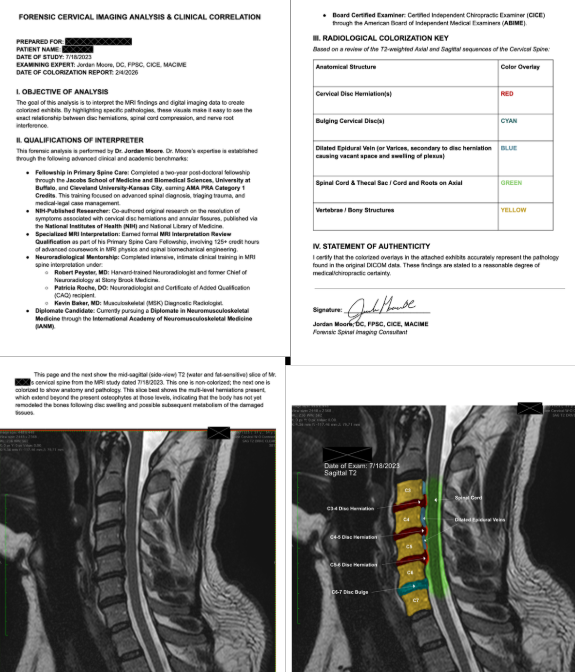
Forensic Cervical Imaging Analysis and Clinical Correlation report by Dr. Jordan Moore — colorized MRI with radiological key

Sample forensic cervical imaging analysis — colorized MRI with radiological key and written clinical correlation by Dr. Moore, FPSC, CICE, MACIME.


Impairment Rating

X-Ray Digitization & AOMSI Reports

X-ray digitization uses specialized software to measure vertebral body angles and translational displacements from flexion-extension radiographic stress views with a precision that exceeds manual visual estimation. These measurements form the basis of Alteration of Motion Segment Integrity (AOMSI) determinations — a specific category of spinal impairment defined in the AMA Guides to the Evaluation of Permanent Impairment, 5th edition, that assigns whole-person impairment based on measured abnormal intersegmental motion.

AOMSI findings are significant in medicolegal matters because they represent objective, radiographically-derived evidence of ligamentous injury rather than subjective symptom reports. A measured finding that meets or exceeds the AMA Guides threshold for a given motion segment supports an impairment rating with a defensible methodological basis — one grounded in published normative data rather than clinical judgment alone.

Dr. Moore prepares AOMSI reports as both treating physician (for his own patients' treating record) and as an independent examiner engaged by attorneys or case managers for existing cases. Reports include the raw measurement data, methodology documentation, normative reference comparison, and a clearly stated impairment conclusion. Dr. Moore is available to testify regarding digitization methodology and AOMSI findings.

AOMSI Report Contents

  • Radiograph Description Date, view, technical quality assessment, and identification of all motion segments measured
  • Measurement Methodology Software platform, measurement technique, and reliability documentation
  • Raw Mensuration Data Angular and translational measurements for each motion segment evaluated, in tabular form
  • Normative Reference Comparison Measured values compared against published normative ranges and AMA Guides thresholds
  • Impairment Conclusion Whole-person impairment rating per AMA Guides 5th edition, section and table cited

For Treating Patients

Letters of Protection

Optimum Chiropractic Care accepts Letters of Protection (LOP) from attorneys handling personal injury cases, allowing patients to receive necessary treatment while their legal matter is pending, with fees addressed at the time of case resolution. Acceptance of an LOP does not alter the clinical treatment decisions made on behalf of the patient — treatment is prescribed based on clinical indication, not case status.

Letters of Protection apply only to patients receiving treatment at the practice. Independent medical evaluations, record reviews, and AOMSI reports are separate engagements in which Dr. Moore has no treating relationship with the examinee.

To discuss LOP arrangements for a specific client, please contact the office directly. We are happy to coordinate with your office on the documentation required. Inquiries may be directed to Dr. Moore's office at (251) 281-8768 or [email protected].

Attorney Inquiries

Contact Dr. Moore's Office

For IME scheduling, AOMSI report requests, record review, or any other medicolegal inquiry, please reach out directly. Dr. Moore's staff can discuss scope, timeline, and scheduling at your convenience.

Phone (251) 281-8768
Address 7681 Old Shell Rd., Mobile, AL 36608
Hours Mon–Thu 8–11:30am & 3–6:30pm · Fri 8–11:30am & 2–5pm · Phone anytime

Send an Inquiry